
'There are major implications for India. Though there was a transparently thin attempt to project the troop reduction as intended to promote peace, the downsizing is actually part of plans to streamline and strengthen the PLA, capable of defending China's national interests at home and abroad,' says Jayadev Ranade.

Chushul and Depsang are not vital in this game of Chinese checkers, the Indian Ocean Region is. Keeping our maritime prowess restricted has to be a key Chinese strategic interest and it would appear that the LAC affair has helped China achieve its aim, points out Vice Admiral Premvir Das (retd).
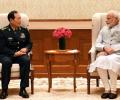
'China's military is expected to deploy full throttle its new equipment including J-20 stealth fighters, drones, medium range missile systems, surveillance and others to continue to put psychological pressure on India,' warns Srikanth Kondapalli, Professor in Chinese Studies, JNU.
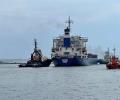
If they can sit together and hammer out 'Black Sea Initiative' deal for much needed food shipments, surely, they should be able to address the madness of the larger military conflict?

'As far as acquisition of Russian equipment is concerned, with about 70% of Indian military equipment being of Russian origin, a sudden decision to abandon imports from Russia is not feasible,' points out Brigadier S K Chatterji (retd).
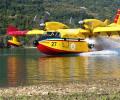
The islands that would be connected through seaplanes are Campbell Bay, Car Nicobar, Havelock, Hutbay, Neil, Long Island and Diglipur, reports Arindam Majumder.

The biggest winner will be the BJP -- which has such a small presence that every incremental vote it gets can only increase its strength. But the man who will win despite losing everything will be Captain Amarinder Singh, predicts Aditi Phadnis.
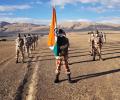
India and China on Friday agreed to hold the next round of military talks at an early date to achieve the objective of complete disengagement in remaining friction points in eastern Ladakh amid fresh sparring between the two sides on the prolonged Line of Actual Control (LAC) standoff.

During the 13-minute special session, Dhammika Dassanayake, ecretary general of Parliament, announced the vacancy for the post of president.
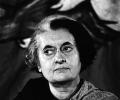
'According to me, her finest hour was in 1983-1984 when she neutralised a combined US-Pakistan-British conspiracy to Balkanise India by creating an independent Sikh State of Khalistan,' says Colonel Anil A Athale (retd). A special assessment of Indira Gandhi on her centenary.
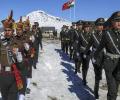
In a joint statement, the two armies said it was agreed to earnestly implement the important consensus reached by the leaders of the two countries and ensure that the frontline troops exercise restraint and avoid misunderstanding and miscalculation.
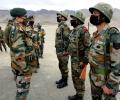
The seventh round of military talks between India and China held on Monday was "positive and constructive", and both sides agreed to earnestly implement the understanding reached by their leaders to not turn differences into disputes, a joint statement by the two armies said on Tuesday.

Naga splinter groups impatient with stalled talks as well as rebel Manipuri groups who have a stake in disrupting upcoming elections to the state assembly, are believed to be regrouping in the borderlands of China's Yunnan province and Myanmar, taking advantage of the turmoil in the latter by using it as a transit corridor.

The government must figure out what the Chinese game plan is and thwart the endgame before it is upon us, possibly in early winter, advises David Devadas.

Since 2016, when India was officially recognised in US law as a 'major defence partner', Washington has purposefully upgraded the defence relationship.

If the Opposition has any chance at the prime minister's job, it can happen only if they all stop dropping names and work at the grassroots-level, state-wise, suggests N Sathiya Moorthy.

North Korea on Friday launched an ICBM for the second time in a month.

Gen Soleimani was killed in a US airstrike on Friday. Trump alleged that Soleimani has been perpetrating acts of terror to destabilise the Middle East for the last 20 yrs.
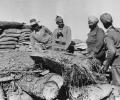
'The Himmatsinghji Report is still 'missing'.' 'It is a great loss for the knowledge of India's borders.' 'It would have an immense value at a time China is bound to shift its attention to other border fronts in the Himalayas,' notes Claude Arpi.

Both sides have completed creation of a buffer zone of three kilometres in the three friction points of Galwan Valley, Gogra and Hot Springs as part of a temporary measure aimed at reducing the possibility of any confrontation.
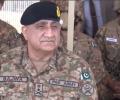
'The picture only looks worse from where Bajwa sits.' 'He sees a domineering India to the east, an unravelling Afghanistan and a complex Iran to the west, an overbearing China on the north and a US which is no longer an ally,' observes Shekhar Gupta.

'The potential of one such LAC engagement going out of control and leading to heavy casualties cannot be ruled out,' warns Lieutenant General Syed Ata Hasnain (retd).

'Did Trump hint at US military intervention in Qatar?' asks Ambassador M K Bhadrakumar.
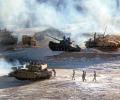
India's national security strategy needs to be revised periodically since the global and regional geopolitical situation is dynamic, points out Commodore Venugopal Menon (retd).
'India cannot allow Beijing's policy of stabilising and destabilising the border at will to perpetuate its own ends.' A riveting excerpt from Manish Tiwari's 10 Flashpoints; 20 Years National Security Situations That Impacted India.

Considering that Qatar is a trusted ally of Washington for decades, it is expected to be a steady influence on the Taliban leadership, observes Ambassador M K Bhadrakumar.

India and China on Friday held 'in-depth' discussions on addressing the remaining issues along the Line of Actual Control (LAC) in eastern Ladakh, holding that disengagement in the North and South banks of Pangong lake provided a good basis to work towards their early resolution.

'Our defence services are in a position to checkmate any Chinese adventurism.'

Tawang wears its history -- and also its present -- with ease. The flourishing town, with restaurants selling everything from noodles to dosas and locals returning home to new business prospects, shows little sign of the tension building up at the border about 40 km away to the north.

The TMC expects to emerge victorious by way of a majority of minority votes and a minority of majority votes, notes Arun Bhatnagar, a retired IAS officer.
Future conflict will involve bypassing of frontiers to strike at critical vulnerabilities directly and in the hinterland at the appropriate time, explains Lieutenant General Anil Chait (retd), who served as chief of the Integrated Defence Staff and Central Army Commander.

The entire gamut of China's activities is aimed at keeping India on tenterhooks, cause fatigue to its troops and keeping its security system unstable, so that it cannot play a meaningful role in international geopolitics as an effective partner of the US and Japan, observes Lieutenant General Syed Ata Hasnain (retd).

'Why did your generals try to grab a few square kilometres of Indian territory in Ladakh?' 'And what happened to the hard work that you and Prime Minister Modi put into the Wuhan and Mamallapuram meets?' Claude Arpi writes a letter to Xi Jinping, China's self-styled supreme leader, who turns 68 today, June 15.

The agreement would divert China's attention and keep them busy in the Pacific theatre, probably resulting in a reduction in threat perception in our area of interest in the Indian Ocean, notes Commodore Venugopal Menon (retd).

'The intrusion in Chumar, during and beyond the Chinese president's visit, is unprecedented and has qualitatively changed the tone of the India-China relationship,' says Jayadeva Ranade, a member of the National Security Advisory Board.
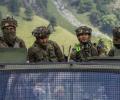
'A breakthrough in eastern Ladakh leading to disengagement and creation of a buffer zone will obviate the need of military deployment through the winter months ahead,' notes Ambassador M K Bhadrakumar.
'We should not minimise the seriousness of Chinese encroachments because their perception is different.' 'Nor should we fall into the trap of accepting so-called 'buffer zones' in areas of overlapping claims. We cannot have buffer zones in our own territory,' asserts Ambassador Shyam Saran, a former foreign secretary.

Even as Priyanka is gaining traction among the electorate and the media, her counterpart for the western UP region, Jyotiraditya Scindia, has been low key and perceptibly missing from the 'heat and dust' of elections in UP, reports Virendra Singh Rawat.

If New Delhi finds itself out in the cold in Afghanistan, both the Congress-led UPA and BJP-led NDA have only themselves to blame. Each has been in power for a full decade from 2001, without reaching out to the Taliban, points out Ajai Shukla.

The cyclone would bring light to moderate rains at most places and 'heavy to very heavy downpour' at some places on November 6.
 © 2026 Rediff.com - Advertise with us - Disclaimer - Privacy Policy - Sitemap - Feedback - About us - Terms of use - Grievances